Ancient Mediterranean Treasures · Port 5

Rhodes

The island of the Knights — a medieval city that time forgot.

📅 Dec 26, 2026⚓ In port 7:00 AM – 6:00 PM🚶 Tour 9:00–11:30 AM🌡️ ~54–61°F🇬🇷 Greece

🔒 December 26 is a Greek public holiday

The Synaxis of the Mother of God — one of only two days a year (with Christmas Day) when Greek state sites and museums close outright rather than run short hours. On Rhodes that shuts the Palace of the Grand Master, the Archaeological Museum and the Acropolis of Lindos for the day. Everything that makes the Old Town the Old Town — the walls, the gates, the Street of the Knights, the moat, Mandraki — is open air and unaffected. The tour we're booked on stays outdoors from start to finish.

It runs wider than the state list, though. The synagogue and Jewish Museum are shut for the winter, shut on Saturdays and shut on state holidays — three separate reasons. The Museum of Modern Greek Art is municipal rather than state and closes on the 26th anyway. The Roloi clock tower shuts November to May, the Suleymaniye Mosque has been closed since 2014 and the hammam since 2011, and the Nea Agora is a building site. Worth knowing before anyone walks somewhere hopefully.

Day 5 is Rhodes: step through the city walls and you're in the largest inhabited medieval town in Europe, knight's-cross banners and all. The ship is alongside from seven in the morning until six at night, and the guided walk takes the first half of it.

Day 5

The plan

How the day runs

Reservation confirmed
7:00 AMAlongside at Rhodes Town
9:00 – 11:30 AMRhodes on Foot · included · moderate
11:30 AM – 5:30 PMAshore, ours to spend
6:00 PMSail for Crete
Rhodes on Foot
With Viking · 9:00–11:30 AM · 2½ hrs
  • Out by coach past the Fortress of St Nicholas and Mandraki Harbour, with a photo stop on Monte Smith above the ancient acropolis.
  • Down on foot into the Old Town: the Street of the Knights, the Gothic Hospital of the Knights, and Hippocrates Square.
  • Past the Palace of the Grand Master — the walk goes by the façade, not inside, which suits a day when the doors are shut anyway.
  • Rated moderate: uneven cobbles and some step-ups, roughly two hours of it on your feet.
The long afternoon
On our own · 11:30 AM – 5:30 PM
  • There are two shapes for it, and it is worth choosing rather than drifting.
  • Inside the walls: the moat under D'Amboise Gate, the inns of the seven langues, Agios Fanourios, the roofless Panagia tou Bourgou, the Square of the Jewish Martyrs, and Hippocrates Square to sit down in. All free, all open — and all on cobbles.
  • Or the flat side: out to Mandraki and its bronze deer, the Evangelismos church, the 1930 nativity at Santa Maria, and a harbourside lunch. Level paving the whole way.
  • They meet at the Marine Gate, so nobody has to commit — but if legs are the constraint, Mandraki is the easier half.
  • Sunset is 4:57. Whatever happens outdoors happens before five.

What to see

Sights & history

The Medieval Old Town Must-see
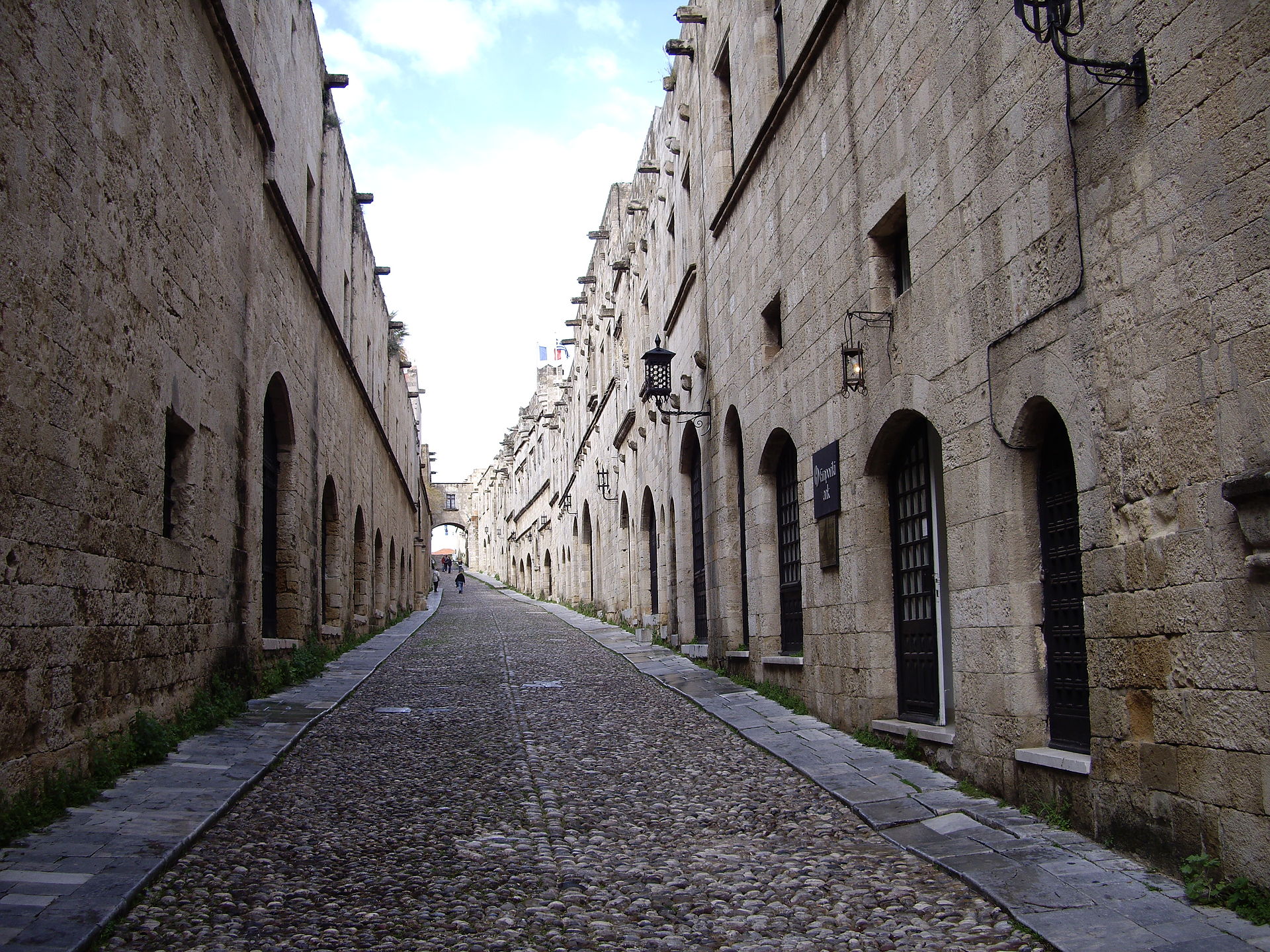
The cobbled Street of the Knights 📍 Rhodes Old Town
History: A UNESCO World Heritage walled city — the largest inhabited medieval town in Europe — built by the Knights Hospitaller after 1309 atop the ancient and Byzantine city.

The morning walks the spine of it; the afternoon is for the rest. The inns of the seven langues — Italy, France, Provence and Spain stand on the Street of the Knights itself, Auvergne on Argyrokastrou Square, England on Museum Square, and Germany's has never been identified at all. Everything on the north side of that street was rebuilt during the Italian occupation, which is why it looks quite so crisp.

Getting in: the Gate of the Virgin is straight across from the port exit, the Marine Gate and its 1478 towers are the photograph everyone takes, and D'Amboise Gate is the one with a step-free route through it. Fair warning that the Street of the Knights is the hardest three hundred metres of the day — big polished cobbles on a continuous climb.

Two free things worth walking to, both open on the 26th: Agios Fanourios, a 13th–14th-century Byzantine church down an alley off Sokratous, a mosque under the Ottomans and still frescoed; and Panagia tou Bourgou, a Gothic church destroyed in the Second World War and left roofless ever since. And on Monte Smith, where the coach stops, the ancient acropolis and stadium are unfenced — the one state site on Rhodes the holiday cannot close.

Palace of the Grand Master Closed our day
📅 Shut Dec 26 — Greek public holiday ⏱ Normally winter Wed–Mon 08:30–15:30 🎟 €20 when open (€10 at 65+)
📍 Palace of the Grand Master
History: The Hospitaller fortress-palace, ruined by a 19th-century explosion and grandly rebuilt under Italian rule in the 1930s; inside, Hellenistic and Roman mosaics.

The commanding set-piece at the top of the Street of the Knights — and the exterior is the half most people photograph. The morning walk stops in front of it.

Lindos & its Acropolis Half-day
🚗 ~50 km · about an hour each way 🏘 Village open 🏛 Acropolis closed Dec 26
📍 Lindos
History: A dazzling white village beneath a clifftop acropolis crowned by the ancient Temple of Athena Lindia, with Doric columns over a turquoise bay.

The arithmetic, so it's a decision rather than a discovery. A taxi is €67 each way on the published rank tariff plus about €12 an hour waiting — call it €150 for the round trip. No winter bus timetable is published at all; KTEL runs Rhodes–Lindos in summer only. That is two of our six hours in a car, the acropolis locked at the top, a village running on a winter skeleton, and sunset at 4:57.

Against all that: it is one of the loveliest villages in the Aegean and none of us has seen it. It is entirely possible — it just costs the whole afternoon, and the thing most people climb for is shut on our date. Worth putting to the family rather than deciding by default.

The Moat Free & open
🎟 Free — unticketed and ungated 📏 ~2.5 km · walls up to 20 m ⚠️ No exits, toilets or water mid-route
History: A dry crescent below the walls — dry by design, because it let the defenders counter-attack down into it and denied besiegers the use of rafts and floating siege towers. Now landscaped as a park.

Not to be confused with the ticketed walk along the top of the walls, which is state-run and shut on our date. The moat is neither ticketed nor gated. A full circuit runs one to two and a half hours and is rough in places, so the sensible version is in at D'Amboise Gate, a few hundred metres for the sheer scale of it, and back out the same way.

The nativity at Santa Maria Christmas
📍 Santa Maria della Vittoria
History: The Catholic church of Our Lady of Victory, in the New Town, holds the oldest nativity scene on the island — built in 1930 under the Italian administration, designed by the architect Armando Bernabiti, its statues brought from Naples at the governor's expense. Some of the figures are dressed as Rhodian villagers in traditional costume.

It goes up every year for the Twelve Days, roughly 23 December to 6 January, so it is open on ours. Flat ground and walkable from Mandraki. Bernabiti also designed the aquarium building at the north end of the island, which is a pleasing coincidence for one afternoon.

Mandraki Harbour Legend
📍 Mandraki Harbour
History: The old harbour entrance where, by tradition, the Colossus of Rhodes once straddled the water (more likely it stood on land nearby).

Bronze deer now mark the spot; a pleasant, breezy stroll.

Optional · for the history loverColossus, Caesars, and an island of exiles History detour

Before the Knights, Rhodes was an ancient maritime powerhouse and a kind of university town of the Roman world. Cicero studied rhetoric here; Julius Caesar came to study and was famously kidnapped by pirates en route; and the future emperor Tiberius spent years in self-imposed exile on the island.

Its most famous sight is gone: the Colossus of Rhodes, a 30-metre bronze statue of the sun-god Helios and one of the Seven Wonders, which stood only ~60 years before an earthquake toppled it around 226 BC. The bronze lay where it fell for centuries; legend says that when Arab raiders took Byzantine Rhodes in the 7th century, they sold the wreckage for scrap. And in 42 BC, Cassius — yes, that Cassius — sacked the city for refusing to fund the assassins' war against Octavian. Layers on layers.

What to eat

Food & drink

Greek classics

Souvlaki, fresh-grilled fish, and crisp local Rhodian white wine.

Island sweet

Melekouni — a sesame-and-honey bar that's the traditional Rhodian celebration treat.

Eating on a public holiday

Two rules, easily confused. Shops close on December 26 — expect Sokratous shuttered. Restaurants don't: food service isn't covered by that law, and Rhodes Town is a working city of fifty thousand rather than a resort that shuts for winter. Hatzikeli in the Old Town opens at one and has traded since 1982; Phournariko is a 24-hour bakery if everything else has failed. Lunch back aboard is a perfectly respectable plan B.

The flat option

If the cobbles have done their work by lunchtime, the Yachting Club Café on the Mandraki dockside is level ground, on the morning tour's own route, and open through the winter.

When we're there

December here

Mild and quiet

The Dodecanese stay gentle in winter, and Rhodes has the mildest nights of the whole voyage — it has never dropped below the low forties on this date in a decade. Sunny more often than not, though a shower is possible. Summer-only draws (the Valley of the Butterflies, beach clubs) are closed, but the Old Town is at its most atmospheric.

One number worth planning around: sunset is at 4:57, and there are only about ten hours of daylight. It is dark well before the ship sails, so anything outdoors belongs to the early afternoon.

Good to know

Andrew's notes

Old Town is at your feet

The walled city is a short walk from the cruise port — no transport needed for the headline sight.

Lindos, if we want it

It fits the afternoon on paper — an hour out, three there, an hour back — and the full case for and against is on the Lindos card above. The short version: €150 in taxis, no winter bus, a locked acropolis and a village on skeleton hours, against one of the loveliest villages in the Aegean. A hire car makes it cheaper and easier; book through a platform rather than the desk, take the full coverage, and know the lanes are narrow and stone-walled. Rhodes Town's tap water is drinkable, incidentally, so there's no need to stock up first.

Winter rhythms

Shops and tavernas keep shorter hours, and because our day is December 26 — a Greek public holiday — the ticketed state monuments are closed outright: the Palace of the Grand Master, the Archaeological Museum, and the Lindos acropolis. The Old Town itself, the Street of the Knights, the moat and Mandraki Harbour are open air and open as always — as is the ancient acropolis on Monte Smith, which is unfenced.

The trap is assuming privately run means open. It doesn't here: the synagogue is shut for the season and on Saturdays and on state holidays; the municipal art museum closes on the 26th too; the clock tower shuts all winter; and the Nea Agora is closed for renovation. The one indoor possibility is the Aquarium at the island's northern tip — run by a marine-research institute rather than the culture ministry, so not bound by the holiday, but nobody official confirms it opens on the day. One phone call would settle it.